

Best DHT Blockers for Men: What the Evidence Shows

A prescription medicine, a botanical ingredient and a branded supplement are not interchangeable just because their marketing mentions DHT. Oral finasteride has established placebo-controlled evidence and FDA approval for male-pattern hair loss in men. That evidence does not validate a supplement or guarantee regrowth.
A useful comparison separates three questions: whether a treatment reduces DHT, whether it improves a meaningful hair outcome, and whether the exact product has been tested. Those questions can produce very different answers.
Table of Contents
- What DHT Blockers Do and What They Cannot Promise
- DHT Blocker Options Compared by Evidence Level
- How to Judge Ingredient Evidence Before You Buy
- Prescription DHT Blockers and Their Trade-offs
- Side Effects, Interactions and Fertility Questions
- Signs Hair Loss Needs a Clinician
- Choosing Your Next Step Safely
What DHT Blockers Do and What They Cannot Promise
A DHT blocker lowers dihydrotestosterone, an androgen involved in shrinking susceptible scalp follicles in men with androgenetic alopecia, also called male-pattern hair loss. Prescription blockers inhibit the enzyme that converts testosterone to DHT. Lowering that signal can help preserve hair, but blocking DHT isn't the same as regrowing hair.
An analogy helps: DHT acts like a signal telling vulnerable follicles to produce progressively finer hair. Reducing the signal can slow that process. It doesn't establish how much visible hair an individual will recover.
Preservation and regrowth are different outcomes
A treatment can be worthwhile even when photographs don't show dramatic filling-in. Maintaining existing hair while untreated hair loss would otherwise progress is a different outcome from restoring density.
The FDA prescribing label’s blinded photographic assessment reported increased hair growth in 48% of finasteride-treated men at five years, no visible progression in 42%, and hair loss relative to baseline in 10%. These are study results, not guarantees; the measured outcome and participants remaining in follow-up matter. Source: https://www.accessdata.fda.gov/drugsatfda_docs/label/2021/020788s028lbl.pdf
Practical rule: A credible hair claim names the outcome being measured, not just the hormone being targeted.
Not every cause of shedding involves DHT
Thyroid disease, nutritional deficiency, inflammation, scalp disorders, stress-related shedding, and medication effects require a different clinical assessment. A DHT-focused product shouldn't be assumed to address those causes.
Readers will encounter prescription enzyme inhibitors, hair-growth agents such as minoxidil, and hair-wellness supplements. These categories have different mechanisms and evidence requirements. The first decision is identifying the likely cause of shedding, not selecting the strongest-sounding bottle.
DHT Blocker Options Compared by Evidence Level
| Option | Category | Main evidence | Regulatory status | Main caution |
|---|---|---|---|---|
| Oral finasteride | Prescription 5-alpha-reductase inhibitor | Placebo-controlled trials in men with male-pattern hair loss | FDA-approved for male-pattern hair loss | Sexual, mood, and other adverse effects require prescriber discussion |
| Oral dutasteride | Prescription 5-alpha-reductase inhibitor | Randomized trials with mixed comparative findings | Not FDA-approved for male-pattern hair loss; use is off-label | Systemic effects and PSA interpretation require clinician review |
| Topical finasteride | Prescription topical enzyme inhibitor | A studied topical spray improved target-area hair count versus placebo; results were numerically similar to the oral comparison arm, not proof all formulations are equivalent | No FDA-approved topical finasteride formulation in the United States | Absorption and formulation can't be assumed equivalent across products |
| Topical minoxidil | Hair-growth agent, not a DHT blocker | An established medical option for androgenetic alopecia | Verify the specific product's Drug Facts and indication | Review scalp tolerability and combination use with a clinician |
| Saw palmetto extract | Botanical ingredient | Few small studies; insufficient evidence for firm conclusions | Dietary supplement when sold as an oral supplement | Limited hair-loss evidence doesn't establish effectiveness or risk-free use |
| FULLHEAD hair-wellness supplement | Hair-wellness supplement | Ingredient-level rationale isn't evidence that the finished formula treats hair loss; no product-level trial is established here | Dietary supplement, not an FDA-approved hair-loss medicine | Review the current label, intended users, and cautions before purchase |
The National Center for Complementary and Integrative Health states that only a few small studies have evaluated oral or topical saw palmetto for male-pattern hair loss, and the evidence is too limited for firm conclusions. That limitation matters more than how often an ingredient appears in online rankings.
What the categories actually mean
Prescription evidence concerns a particular medicine, formulation, population, and outcome. Ingredient research concerns the material tested in that experiment. Neither automatically establishes that a different commercial blend delivers the same result.
The supplement row reflects a hair-wellness category and ingredient-level rationale, not proof that the finished formula blocks DHT. Its exact ingredient forms and amounts must be assessed separately from claims about prescription medicines.
Minoxidil belongs in this comparison because clinicians commonly discuss it alongside finasteride. It isn't a DHT blocker, so describing every hair product as a hormonal treatment obscures an important difference.
A buying category isn't a clinical endorsement
The hair-wellness collection organizes products by their intended shopping goal. That organization doesn't establish suitability for a diagnosed condition or turn a supplement into an approved treatment.
The table's order summarizes evidence categories. It isn't a recommendation, an automatic ranking, or a claim that the first option is appropriate for every adult man.
How to Judge Ingredient Evidence Before You Buy
Start with the Supplement Facts label, not the front-of-bottle promise. Record each ingredient, its form, its amount per serving, the serving size, and the cautions. A combined blend weight doesn't reveal the amount of every component.
Newt Nutrition's hair formula includes a 1,500 mg complex containing saw palmetto fruit extract, pumpkin seed oil powder, ashwagandha root extract, stinging nettle root extract, rosemary leaf extract, and beta-sitosterol. That identifies the ingredients and total complex weight, but it doesn't establish each botanical's individual dose or demonstrate a clinical effect from the combination.
Eight checks that separate plausibility from proof
- Study population: Research in men with diagnosed androgenetic alopecia answers a different question from research in generally healthy adults.
- Ingredient form: A result for a particular extract, preparation, or topical application doesn't transfer automatically to another form.
- Dose comparison: The label must disclose enough detail to compare the ingredient amount with the study; a trial dose isn't a self-treatment instruction.
- Duration: The study needs an observation period suited to its hair outcome, rather than treating a brief change in a laboratory marker as visible regrowth.
- Comparator: A placebo-controlled design provides a stronger basis for attributing improvement to treatment than an uncontrolled before-and-after comparison.
- Outcome definition: Baseline values, change within a treatment group, and the difference versus placebo are distinct measurements.
- Study size and replication: A small isolated experiment leaves more uncertainty than consistent findings from independent trials.
- Statistical uncertainty: Confidence intervals and nonsignificant subgroup findings belong in the interpretation, even when a headline emphasizes a favorable average.
A heterogeneity-test P value describes variation between studies. It isn't a test proving that a treatment works.
Apply the checklist to an actual bottle
A label can answer composition questions without answering efficacy questions. It won't ordinarily establish the study population, comparator, confidence intervals, or performance of the finished formula.
For this botanical complex, total blend weight cannot establish whether any individual extract matches a studied preparation. A marketing statement about healthy DHT balance does not itself establish measured DHT reduction, hair preservation or regrowth. Those claims require evidence for the actual formulation and outcome.
A transparent label makes a product easier to evaluate. It doesn't replace a controlled clinical trial.
A useful comparison sheet therefore needs separate entries for confirmed, not disclosed, and not clinically established. Missing information should remain missing rather than being filled with assumptions drawn from competing products.
Prescription DHT Blockers and Their Trade-offs
Prescription finasteride and dutasteride have controlled clinical trial evidence, but differ in approval status, formulation and safety considerations. Finasteride inhibits mainly type II 5-alpha-reductase. Continued treatment is generally needed to maintain its benefit. Small supplement trials also exist, but are not equivalent to the drug evidence or proof for a different commercial blend.
The American Academy of Dermatology's male-pattern hair-loss treatment guidance reports that finasteride slows further hair loss in roughly 80%–90% of men taking it, while also urging discussion of adverse effects and treatment expectations with a dermatologist.
Trial figures and their limits
The table separates hormonal measurements from hair outcomes. A serum, scalp, or intraprostatic DHT change is a different endpoint from visible density, and results from separate studies are not a head-to-head ranking.
| Option | DHT reduction | Trial result | Notes |
|---|---|---|---|
| Finasteride, 1 mg daily | Larger scalp and serum DHT reductions are reported in clinical reviews | Phase 3 study summaries describe stabilization in most treated men, with a smaller subgroup showing visible regrowth over longer follow-up | Maintenance treatment; definitions and follow-up length shape the reported outcome |
| Dutasteride, 0.5 mg daily | Deeper systemic suppression in reviews, including serum and intraprostatic measurements | A 917-man randomized trial found daily dutasteride 0.5 mg superior to daily finasteride 1 mg and placebo on measured hair outcomes at 24 weeks; this does not guarantee an individual result | Off-label for hair loss in the US; can substantially lower PSA |
| Topical finasteride, 0.25% | No comparable quantitative estimate established here | At 24 weeks, a studied topical spray improved target-area hair count versus placebo (20.2 versus 6.7 hairs); the oral arm was numerically similar, not a proven equivalence result | Findings apply to the studied formulation; absorption and regulatory status need verification |
The topical spray findings apply only to the tested formulation, dose and study population. Numerical similarity to an oral comparator does not prove equivalence, and small adverse-event differences do not establish that every topical preparation is safer. Primary trial: https://pubmed.ncbi.nlm.nih.gov/34634163/ . FDA states there is no approved topical finasteride formulation in the US; compounded preparations can be systemically absorbed and have been associated with sexual and mood adverse-event reports. Transfer to other people is also a concern. FDA alert: https://www.fda.gov/drugs/human-drug-compounding/fda-alerts-health-care-providers-compounders-and-consumers-potential-risks-associated-compounded
The FDA prescribing label describes three double-blind, randomized, placebo-controlled studies lasting 12 months, evaluating 1,879 men, primarily ages 18–41, with 88% Caucasian participants; in the vertex trials, finasteride produced a 107-hair advantage over placebo within approximately 5.1 cm², comparing 679 treated men with 672 placebo recipients. That advantage is a between-group difference, so it cannot be read as a guaranteed regrowth count for each treated man.
Why stronger suppression isn't the whole answer
Dutasteride inhibits type I and type II 5-alpha-reductase and has longer-lasting systemic exposure. A 917-man randomized trial found 0.5 mg daily superior to finasteride 1 mg daily on measured hair outcomes at 24 weeks. Studies using intermittent dutasteride dosing are not direct tests of the same daily regimen. Its use for hair loss is off-label in the US and requires a prescriber’s benefit-risk assessment. Trial: https://pubmed.ncbi.nlm.nih.gov/24411083/
A drug-level result also differs from ingredient-level research and from evidence on a finished commercial formula: a positive prescription trial cannot validate a botanical label, and a botanical label cannot borrow prescription endpoints. Prostate history belongs in the prescribing discussion too. A bladder-control product category can organize urinary-support supplements, but it cannot evaluate urinary symptoms or interpret PSA during prescription treatment.
Side Effects, Interactions and Fertility Questions
Systemic DHT reduction isn't confined to the scalp. A medicine selected for hair preservation can affect other androgen-sensitive functions, which makes a sexual-health and reproductive-history discussion part of responsible prescribing.
The NCBI Bookshelf clinical review of finasteride describes concerns including decreased libido, erectile or ejaculation problems, reduced ejaculate volume, and potential reproductive effects. Mood symptoms also deserve discussion rather than dismissal. These are potential adverse effects, not predictions that every person will experience them.
Sexual symptoms and conception planning
A clinician should know about existing sexual symptoms, prior fertility difficulties, and current conception plans before treatment begins. New or persistent symptoms deserve assessment rather than being automatically attributed to aging, anxiety, or the medicine alone.
Semen volume isn't sperm count. The amount of fluid ejaculated can't establish sperm concentration, motility, or the chance of conception. A supplement marketed for hair or reproductive wellness can't answer those questions.
Browsing male reproductive-wellness supplements may help distinguish product goals, but it doesn't replace a fertility evaluation. Couples with concerns need clinical assessment rather than a decision based on visible semen volume.
Finasteride can also lower prostate-specific antigen, or PSA. The clinician interpreting a screening result needs the medication history, including current and previous DHT-reducing treatment.
Supplement cautions require their own review
Prescription adverse-effect profiles shouldn't be copied onto botanicals as though the products were identical. The opposite shortcut is equally misleading: uncertain supplement evidence doesn't establish that the supplement is harmless.
Newt Nutrition's formula-specific precautions include:
- Medication use: Physician review is needed before use, particularly with blood thinners, blood-pressure medication, or hormone therapy.
- Existing conditions: A thyroid or hormone-sensitive condition warrants a physician conversation before starting.
- Planned surgery: The surgical team should receive the complete supplement list.
- Overlapping nutrients: The hair formula shouldn't be combined with other high-dose iodine or selenium supplements.
Extract-specific safety information matters. Evidence about a particular preparation can't establish the safety of every extract, concentration, or blend containing the same plant name.
Decision standard: The appropriate trade-off considers hair preservation, sexual health, conception plans, and prostate monitoring together.
A clinician or pharmacist can review the actual medication list and bottle label. A general statement that a product is natural can't perform that interaction check.
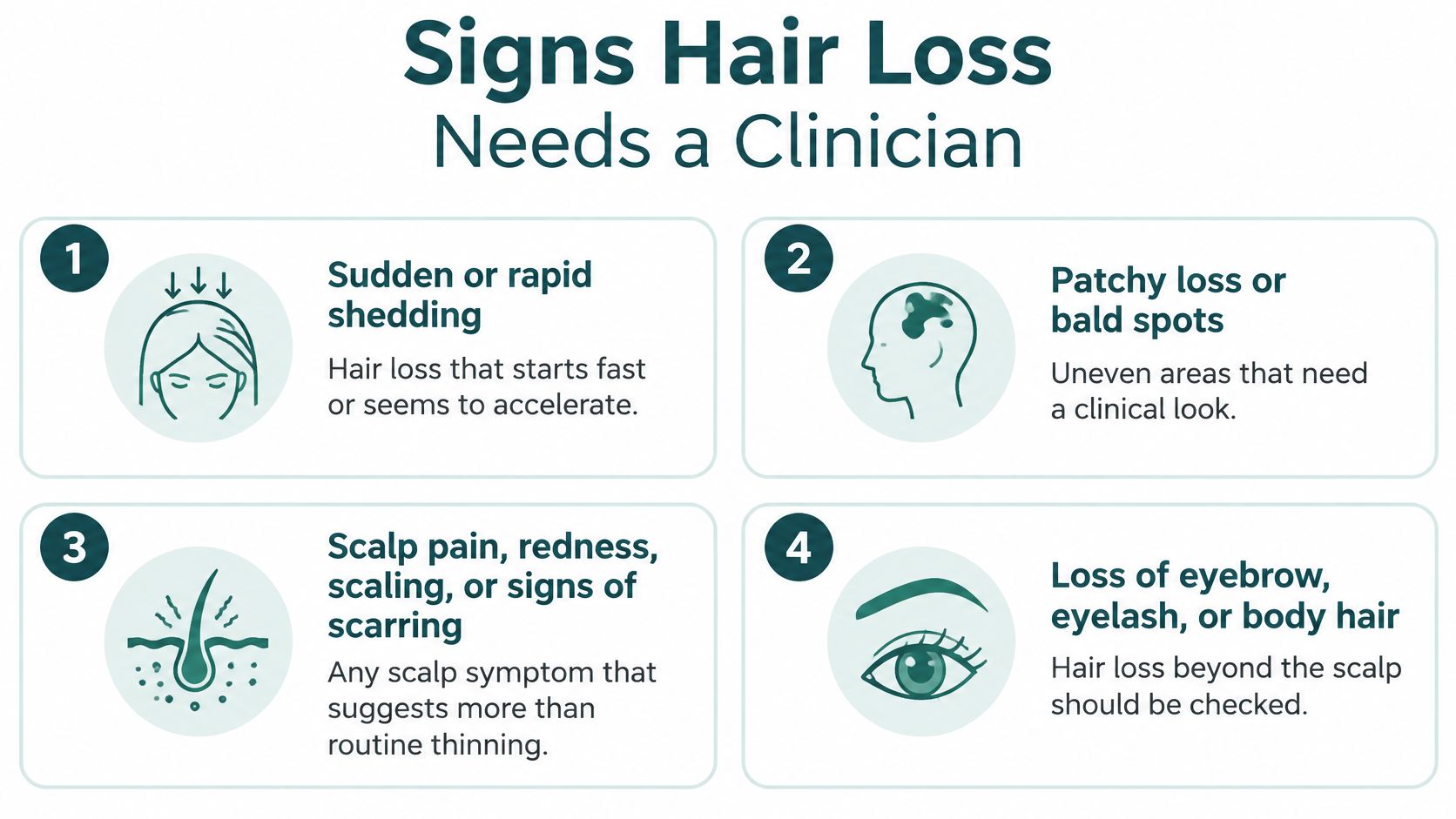
Signs Hair Loss Needs a Clinician
Some patterns of loss sit outside what any label can address, DHT claim or otherwise. The evidence behind DHT-blocking treatment applies to pattern hair loss, and several treatable conditions imitate it closely enough that the difference only appears under examination.
- Sudden or rapid shedding: A fast change deserves assessment rather than an assumption of routine male-pattern thinning.
- Patchy loss or bald spots: Uneven areas require a scalp examination.
- Scalp symptoms: Pain, redness, scaling, or possible scarring should be evaluated.
- Hair loss beyond the scalp: Loss affecting eyebrows, eyelashes, beard, or body hair needs clinical attention.
- A recent health or medication change: Shedding after illness, surgery, childbirth, or a medication change provides important diagnostic context.
- Other physical symptoms: Fatigue, weight change, or temperature sensitivity belongs in the medical history.
What a clinical visit can clarify
A clinician can examine the scalp, assess the distribution of thinning, and review medications and supplements. Bloodwork may be appropriate when the history or examination suggests a nutritional, thyroid, or other medical contributor.
Testing, chosen from that history and examination, distinguishes conditions that can look identical in a bathroom mirror but require different management. The distinction decides which evidence base even applies: prescription trial results and ingredient research on pattern loss say nothing about shedding driven by thyroid dysfunction, deficiency, or inflammation. Treating one of those causes with a DHT blocker means testing the wrong mechanism.
Before a prescription decision, the prescriber may also review sexual symptoms, mood history, fertility goals, and prostate-screening considerations.
A photograph alone can't provide that context.
What belongs in the appointment record
A useful appointment record includes a timeline of shedding, photographs taken under consistent lighting, family history, and a complete medication and supplement list. Bottle photographs should show both Supplement Facts and warnings, not just the product name. Each formula's "Who it's for" section lists the cautions specific to that product, and those details shape what the clinician advises.
New dizziness, fainting, or urinary symptoms call for prompt medical assessment rather than another product switch. Trouble urinating or blood in the urine raises the urgency, and severe symptoms warrant urgent care.
An assessment may identify a cause or clarify which further evaluation is needed, even when no medicine is prescribed. A definite diagnosis is not guaranteed at the first visit.
Choosing Your Next Step Safely
The strongest decision path puts diagnosis before mechanism, and mechanism before marketing. A product can have a plausible rationale while still lacking evidence for the outcome that matters to the person buying it.
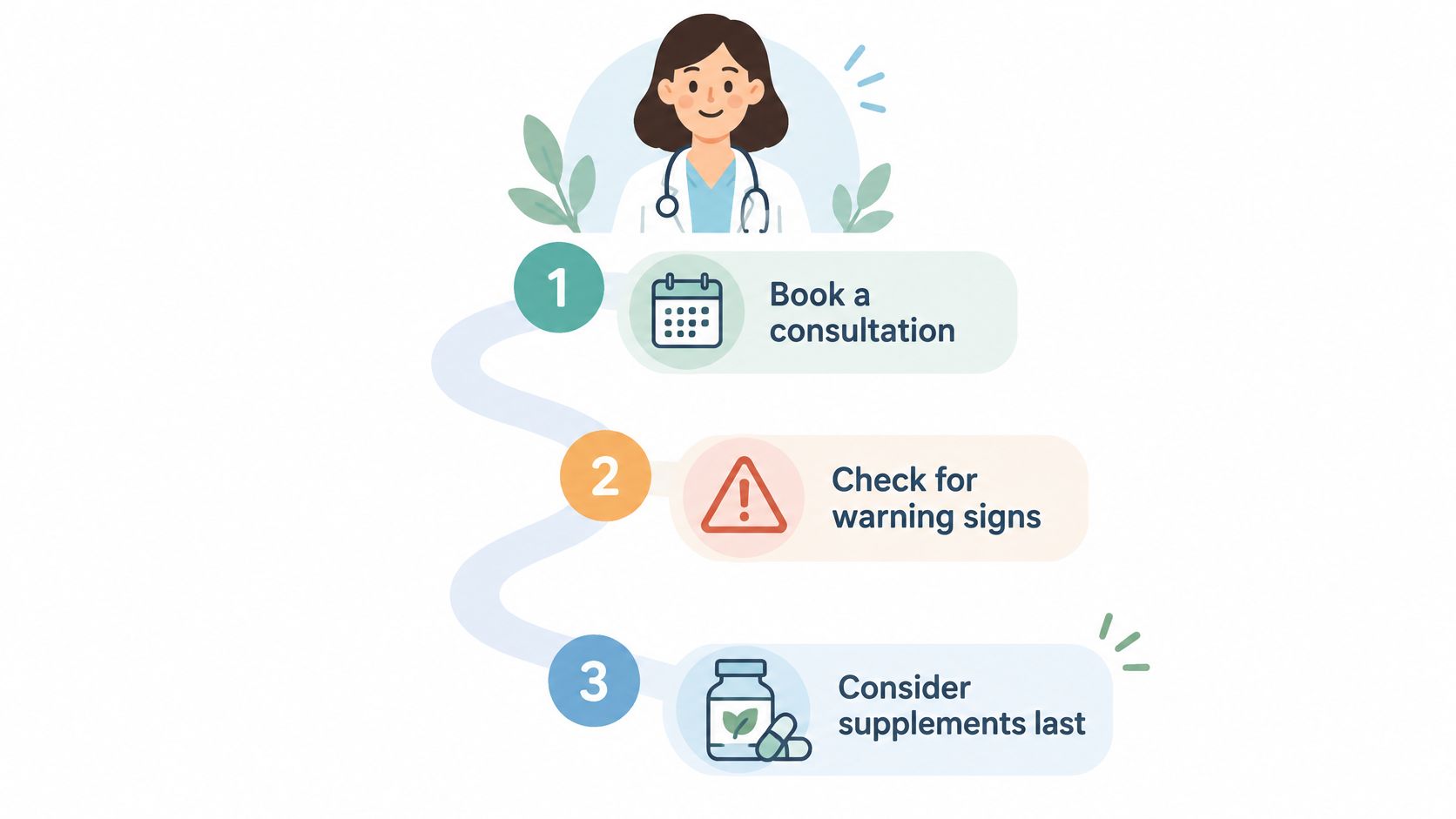
A practical decision path
- Arrange an assessment when the cause is uncertain. Progressing thinning, sudden shedding, scalp symptoms, or unusual patterns warrant a clinician's evaluation before another product is added.
- Compare medical options using meaningful outcomes. The prescribing conversation should address preservation versus regrowth, formulation, adverse effects, and personal sexual-health, fertility, or PSA considerations. The existing prescribed plan should remain in place unless the clinician changes it.
- Treat a supplement as an optional wellness purchase. The current Supplement Facts, directions, and intended-user cautions matter more than a DHT headline. The hair formula's stated directions are three capsules daily, and it is intended for adults 18 and over, not women who are pregnant, nursing, or trying to conceive.
- Create a consistent photo record. Dated photographs with the same lighting, camera angle, hairstyle, and scalp exposure are more useful than repeated checks under changing conditions. The clinician can recommend an appropriate follow-up schedule.
- Bring the evidence and the bottle to follow-up. A photo log, medication list, and actual label allow a more useful review than a recollection that shedding seems better or worse.
Define success before spending
A realistic plan names what will be monitored and what would trigger reassessment. That might mean clinician-assessed progression, consistent photographs, tolerability, or clarification of a suspected underlying cause.
A hair-wellness supplement isn't a substitute for medical evaluation or approved treatment. A suggested period of consistent use also isn't a clinically established deadline for regrowth, and it shouldn't delay assessment of worsening symptoms.
No timeline, density improvement, or regrowth result is guaranteed. New dizziness, fainting, or urinary symptoms need prompt medical attention rather than an extended trial of another supplement.
Newt Nutrition offers hair-wellness supplements with ingredient information and formula-specific usage cautions for adults comparing their options. Visit Newt Nutrition to examine the product information, then bring the label to a clinician or pharmacist for a suitability review before adding it to a hair-care plan.

