

Copper Supplements for Gray Hair: What the Evidence Shows

Can a copper capsule bring color back to gray hair? Current evidence does not show that copper supplements reverse ordinary age-related gray hair; copper matters for color mainly when a clinician confirms deficiency. Two numbers frame every buying decision: the NIH Office of Dietary Supplements copper fact sheet lists 900 micrograms a day as the adult recommendation and 10,000 micrograms, or 10 mg, a day from food, beverages and supplements combined as the tolerable upper intake level.
The Supplement Facts panel answers only part of the safety question: what is in this bottle? It cannot answer the better one: what is your daily total once the multivitamin, zinc lozenge from cold season, fortified drink and new hair formula are counted together?
Copper earned its reputation fairly. It sits inside enzymes that help build melanin, so too little can leave pigment production short. That mechanism explains why copper matters. It does not prove that extra copper recolors hair in someone whose intake is already adequate. Treat gray hair alone as a reason to review diet, medications and labs, not as a prescription for another capsule.
Table of Contents
- Short Answer on Copper and Gray Hair
- How Copper Supports Pigment and Where the Link Stops
- What the Premature Graying Studies Measured
- Adding Up Copper Across Every Product You Take
- Warning Signs That Need a Clinician
- Confirm Your Copper Total Before You Buy
Short Answer on Copper and Gray Hair
Does gray hair by itself justify a copper supplement? The honest answer comes in grades, because each claim about copper and graying sits at a different level of proof.
What the evidence supports on copper and gray hair
| Claim | Evidence-based answer | Strength of evidence |
|---|---|---|
| Copper plays a role in pigment biology | Copper-dependent enzymes take part in melanin production | Established biology; no proof for hair color change |
| Lower copper goes with premature graying | Lower mean serum copper appeared in small case-control studies | Association only |
| Copper supplements reverse ordinary age-related gray | The cited studies do not demonstrate reversal in adults with adequate copper status | No direct evidence |
| Gray hair alone shows copper deficiency | Gray hair by itself does not confirm low copper | Requires clinical assessment |
| More copper is a safer hair strategy | Excess copper can cause gastrointestinal symptoms and liver damage, which is why a tolerable upper intake level exists | Documented harm, unproven benefit |
Biological mechanism, observational association and demonstrated treatment benefit are different kinds of evidence. The studies cited here do not establish that extra copper restores color in copper-sufficient adults. Excess intake can cause harm, so uncertainty about benefit is not a reason to increase the dose.
The practical rule: if gray hair is the only concern and copper status has never been assessed, a copper product isn't supported by the evidence on its own.
Two conclusions follow. Gray hair alone is a reason to find out where you stand before reaching for a supplement. And the value of any formula depends on your total copper intake, since the question is whether you need more of it.
How Copper Supports Pigment and Where the Link Stops
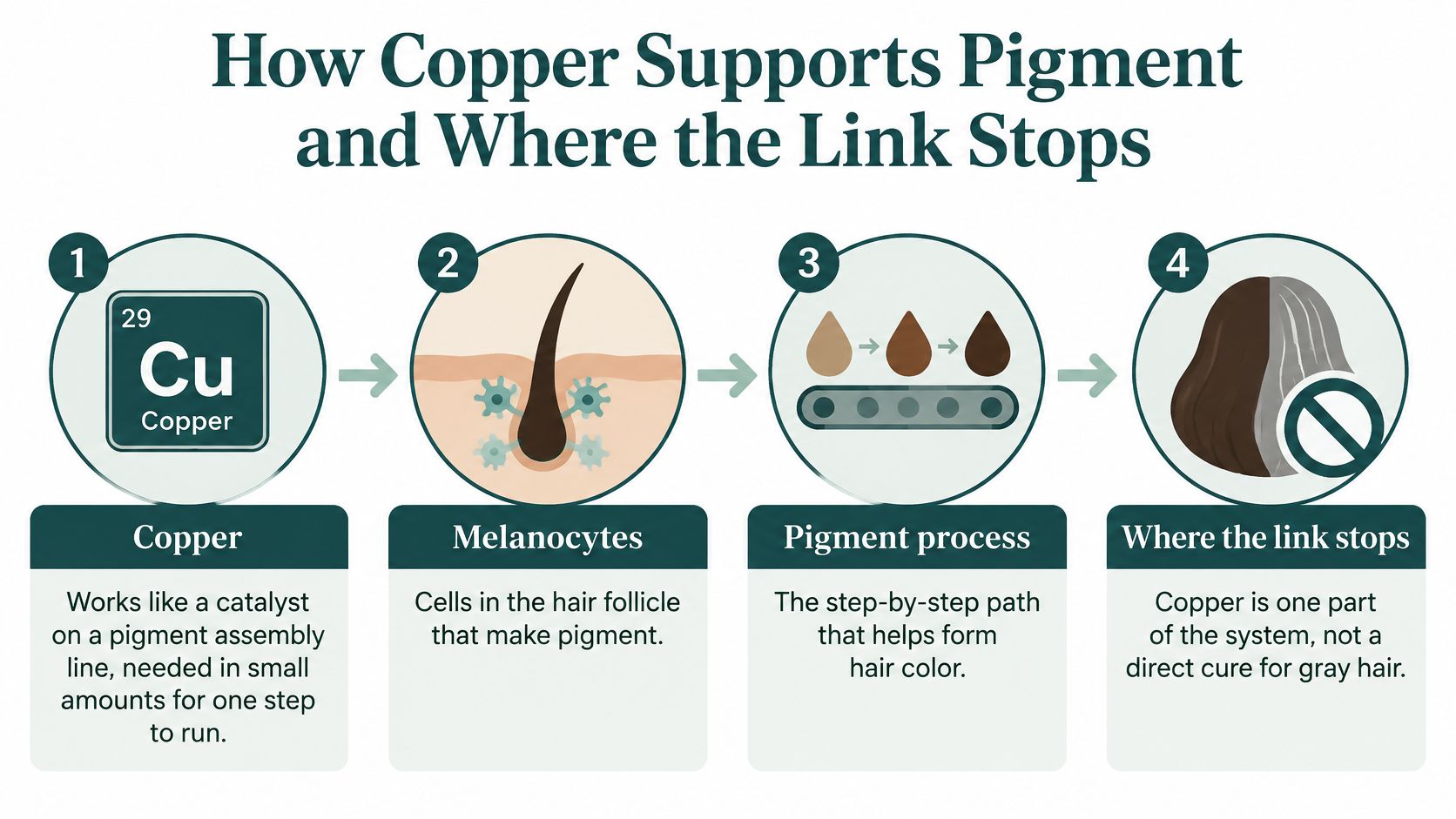
Think of a pigment assembly line inside each hair follicle. Copper is one catalyst on that line, needed in tiny amounts so a single step can run.
Hair color comes from melanocytes, cells at the base of the follicle that build melanin and inject it into the shaft while the hair grows. The step that matters converts the amino acid tyrosine toward the melanin precursor, and the enzymes that run it, including the tyrosinase family, depend on copper. When copper is scarce, that step stalls even though the melanocyte is alive and the raw material is sitting right there.
The mineral's job list runs longer than hair. The NIH credits copper with roles in connective-tissue formation, iron metabolism, energy production and nervous-system function, which is why a true deficiency shows up as more than a color change. Hair is the tissue where the dependency is easiest to notice.
Where deficiency evidence ends and marketing begins
The biology isn't in dispute. A review of copper and hair pigmentation published in the International Journal of Dermatology notes that copper-dependent enzymes take part in melanin synthesis, and that human and animal evidence shows clinically significant deficiency can produce hypopigmentation. The same review draws the line that marketing steps over: none of this establishes that supplemental copper reverses ordinary, age-related gray hair. The evidence is most relevant when a deficiency is documented or strongly suspected.
Hair color also depends on age, genetics, follicle biology and how many pigment cycles a follicle has left. An adequate-copper body doesn't repigment just because more copper arrives.
Why a hair sample isn't the answer
A hair-strand test alone should not be used to diagnose copper deficiency. Copper status needs clinical interpretation; the NIH notes that no single biomarker reliably measures copper status. Serum copper and ceruloplasmin can be affected by inflammation, infection and other factors.
What replaces it is a total intake calculation, a look at risk factors, and, when clinically appropriate, serum copper and ceruloplasmin read by a healthcare professional. For readers comparing products rather than diagnosing themselves, the hair support collection lets you line up formulas by what's printed on the panel.
What the Premature Graying Studies Measured
A case-control study works like a photograph taken after the fact. It shows who had gray hair and what their blood looked like on that day, but it cannot replay what happened before the shutter clicked. Keep that frame in mind and the numbers below sort themselves out.
The 2011 case-control study from Iran compared 66 people younger than 20 who had at least 10 gray hair fibers with 66 controls, measuring serum iron, zinc and copper. Mean serum copper was 90.7 ± 37.4 µg/dL in the premature-graying group against 105.3 ± 50.2 µg/dL in controls, a statistically significant difference reported at P = 0.048, as detailed in Biological Trace Element Research. The authors concluded that lower serum copper might play a role in premature graying, then said additional research was needed to establish the mechanism.
A second case-control study compared 60 people with premature graying with 30 age- and sex-matched controls. Its abstract reported lower serum copper, iron and calcium in the graying group. This observational comparison did not administer copper, establish an effective supplement dose or demonstrate reversal of gray hair. Primary abstract: https://pubmed.ncbi.nlm.nih.gov/30783336/
Two premature-graying studies compared
| Study | Participants | Copper result | Main limitation |
|---|---|---|---|
| 2011 case-control, Iran | 66 people under 20 with premature graying vs 66 controls | 90.7 ± 37.4 vs 105.3 ± 50.2 µg/dL; P = 0.048 | Association only; no copper supplement tested |
| Second case-control, premature graying | 60 people with premature graying vs 30 age- and sex-matched controls | Lower serum copper reported in the abstract; observational association, not treatment evidence | No supplement, no effective dose, no reversal shown |
How to read a case-control result without overreaching
- Copper was measured once, in people who already had gray hair. Nobody received a capsule, so there is no treated group and no placebo-adjusted number to quote.
- Small samples move averages. A control-group spread as wide as 185.95 µg/dL means a few participants can drag the mean around. Sixty people can generate a hypothesis; they cannot set a dose.
- A P value is not an effect size. P = 0.048 describes how unlikely that gap is under chance in that sample. It says nothing about how much pigment a capsule could return.
- The suggestion that supplementation might help was a call for investigation. A possibility flagged for future research sits far from a dosing recommendation.
What these studies support is a specific, modest conclusion: premature graying is a reasonable prompt to look at copper status and total intake with a clinician. It is not evidence that extra copper restores color. For readers thinking about the broader picture rather than one strand, the healthy aging collection groups formulas by goal instead of by a single cosmetic outcome.
Adding Up Copper Across Every Product You Take
NIH lists a recommended copper intake of 900 micrograms daily for nonpregnant, nonlactating adults age 19 and older, rising to 1,000 micrograms in pregnancy and 1,300 while breastfeeding. The adult upper limit is 10,000 micrograms (10 mg) daily from food, beverages and supplements combined. An upper limit is not a target or a guarantee that supplementation is appropriate. Copper deficiency is uncommon in the United States.
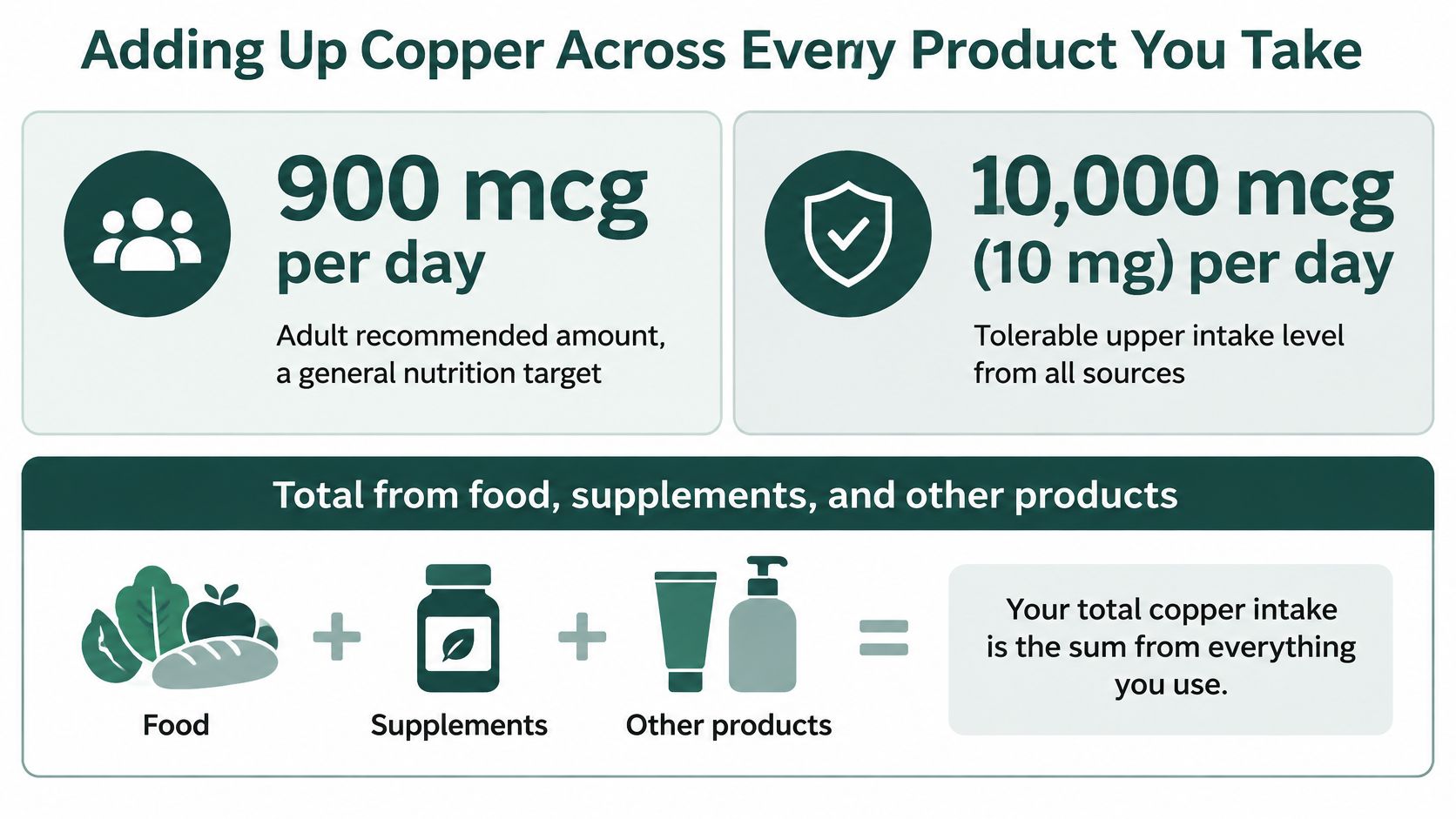
That ceiling marks a limit, nothing more. A formula that ships 1,000 µg and boasts about exceeding the recommended amount has said nothing about hair, because that recommendation describes what a healthy adult needs from food rather than a bar a capsule should clear. The prevalence point matters here too. Since deficiency is uncommon, gray hair on its own is a reason to evaluate your total intake and your overall health rather than a signal that a copper capsule is missing.
Elemental copper is not compound weight
Supplement Facts panels list the elemental mineral. Two milligrams of copper from a bisglycinate chelate is 2 mg of copper, not 2 mg of chelate. The chemical form works like the delivery vehicle and sits in the ingredient list, while the elemental amount, the cargo that counts, sits in the column. Compare the second number.
Unit conversion trips people up more than anything else. 1 mg equals 1,000 mcg, so a panel reading 1 mg is 1,000 µg, and a 1,000 µg capsule plus a 2 mg mineral tablet already totals 3,000 µg before food is counted.
Know who the numbers were written for. The 10,000 µg ceiling was set for healthy adults. People with liver disease, malabsorption or medication-related nutrition concerns fall outside that assumption and need medical evaluation before supplementing at all.
The five-step total intake routine
- List every source. The multivitamin, a single-mineral copper product, fortified foods and drinks, a zinc formula that includes copper, and the gray-hair product you're considering.
- Record the elemental amount per serving from each Supplement Facts panel, converting everything to micrograms.
- Multiply by the servings you take, not the serving size you'd prefer to take.
- Add the rows.
- Compare the total with 10,000 mcg as a ceiling, never as a figure to reach.
Daily copper total worksheet
| Source | Elemental copper per serving | Servings per day | Daily copper |
|---|---|---|---|
| Multivitamin or mineral product | Copy the figure from the Supplement Facts panel | Count what you really take | Multiply the two columns |
| Hair formula being considered | Check whether copper appears at all | Per label | Add to the running total |
| Single-mineral copper product | Usually the largest single number in a stack | Per label | Add to the running total |
| Fortified foods or drinks | Read the nutrition panel, not the front of the pack | Per day | Add to the running total |
| Total daily copper compared with 10,000 mcg upper limit | Sum of the rows above | n/a | Must stay below 10,000 mcg |
Include copper from your usual foods and drinking water as well as supplements and fortified products; the worksheet is incomplete without these sources. The adult upper limit applies to the combined intake, is not a target, and does not guarantee that supplementation is appropriate for an individual.
Zinc sits on the same pathway
Copper and zinc compete for absorption in the gut, so a long stretch of high-dose zinc can pull copper status down even when dietary copper looks fine. The ceiling exists mainly to protect the liver, which is why self-prescribing copper to counter a zinc routine is a poor trade: both the cause of the imbalance and the dose required to correct it need proper assessment.
Read zinc and copper on the same panel. If a zinc product supplies a large dose and no copper, bring that to a clinician rather than adding a copper capsule and hoping the ratio sorts itself out.
What a transparent panel looks like
- The form and the elemental amount. A serious label states both, per serving, in plain micrograms or milligrams.
- The serving size you'll take. If the label serving is one capsule and your routine is two capsules twice a day, that's four times the per-serving copper, and the front of the bottle rarely mentions it.
- Guaranteed repigmentation language. Promises to restore natural color or treat premature graying are a warning sign, not a feature.
- Whether copper is listed at all. Some color-support formulas skip it entirely, and adding a separate copper product on top is exactly where totals climb.
A label that answers all four questions tells you precisely where the product lands in your worksheet, which is the only place a gray-hair formula earns or loses its spot.
Warning Signs That Need a Clinician
Gray hair by itself is not a diagnosis. The situations that do call for a clinician share one feature: something beyond pigment is going wrong, and a supplement bottle cannot answer it.
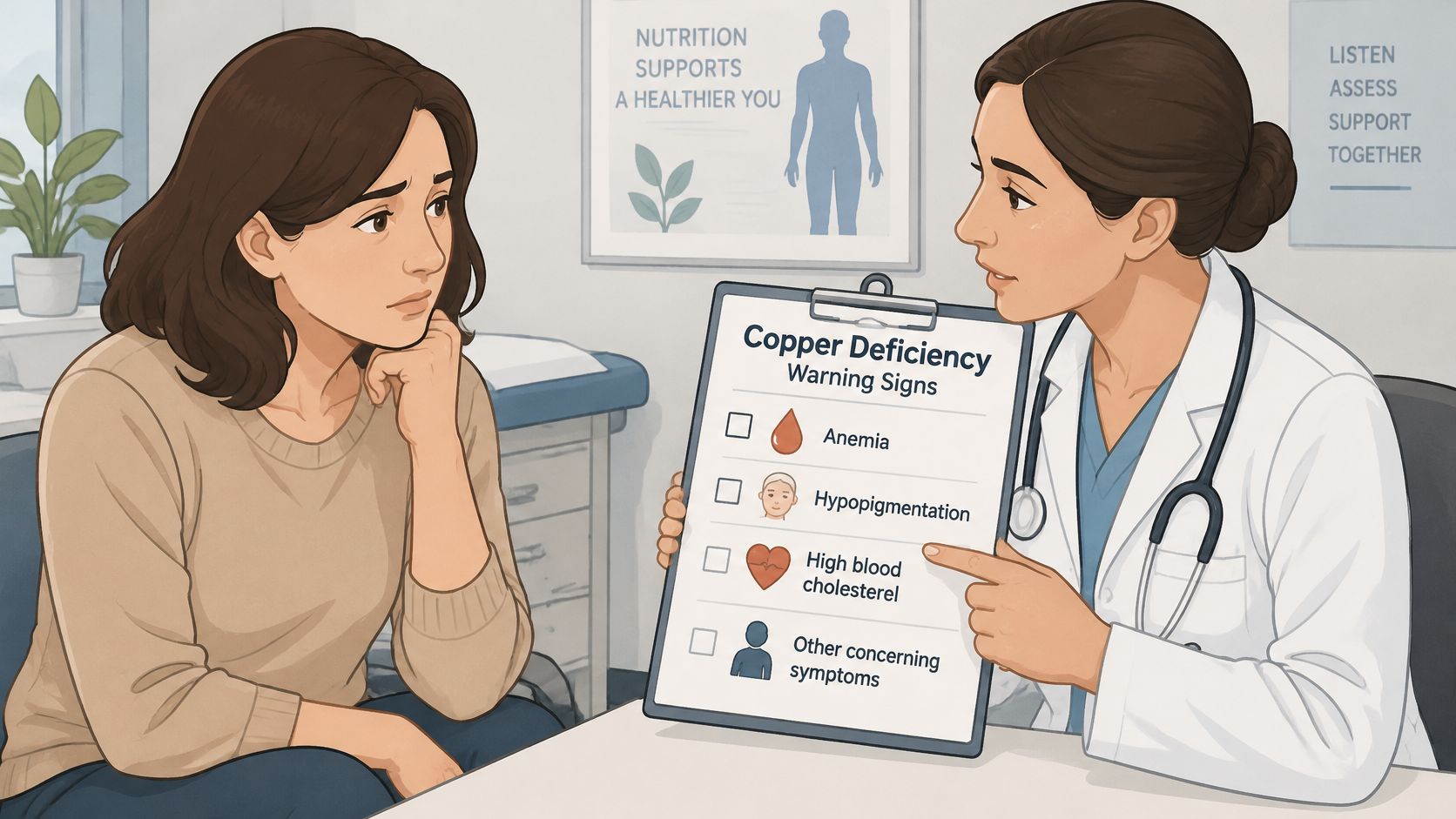
The NIH professional copper resource lists recognized effects of low copper that can include anemia, hypopigmentation, high blood cholesterol, connective-tissue problems, weak or brittle bones, impaired balance and coordination, and increased infection risk. Every one of those signs has other common explanations, so none of them confirms low copper by itself. The same resource links chronic excess to gastrointestinal symptoms and liver damage, which is why guessing in either direction is a poor plan.
When copper questions need professional care
| Situation | Why it matters | Next step |
|---|---|---|
| Fatigue, anemia-like signs, weak bones, poor balance or frequent infections | True copper deficiency is uncommon, and each of these signs has many more frequent causes | Ask a clinician to evaluate, including serum copper and ceruloplasmin when appropriate |
| Liver disease or Wilson disease | Copper handling can be impaired and excess copper is a specific concern | Get specialist guidance before any copper-containing product |
| Malabsorption condition or long-term high-dose zinc | Copper status can fall over time | A clinician decides whether testing and any copper dose are needed |
| Sudden, patchy or widespread graying | Graying can have causes beyond copper | Seek medical evaluation instead of escalating supplements |
| Dizziness, balance problems or urinary symptoms | These symptoms need assessment and should not be guessed at | Arrange medical assessment promptly |
| Taking prescription medication | Nutrition products can raise medication-related concerns | Check with a physician or pharmacist before adding copper |
What a clinician checks
When the picture is unclear, testing means serum copper and ceruloplasmin, interpreted against your history rather than against a single cutoff. Wilson disease, a genetic disorder of copper handling, changes the entire calculation. So does any liver condition, because the organ that regulates copper is the one most exposed to excess.
Gray hair that arrives gradually over the years is cosmetic. Graying that is sudden, patchy or rapidly spreading is a clinical clue, and it earns a visit before any supplement does.
Bring the labels and the worksheet to that appointment. Two minutes of arithmetic gives a clinician more to work with than a description of a capsule someone saw online.
Where self-treatment goes wrong
Adding high-dose copper to chase a cosmetic outcome puts treatment ahead of diagnosis, which is the sequence that turns a harmless gray streak into a real problem. Don't stop prescribed care to try a mineral, and don't treat unexplained dizziness, balance trouble or urinary symptoms as a self-diagnosis project. Those need assessment, promptly.
Confirm Your Copper Total Before You Buy
The buying decision gets simple once the arithmetic is done. Before you compare any two formulas, run the worksheet from the Adding Up section: gather the Supplement Facts panel from every product in the house, total the elemental copper per day, and note the zinc alongside it. That one number tells you whether a new product fits your daily budget or pushes past it.
Then read the product page the same way you read a label. Newt Nutrition groups its shop by goal, including Hair Growth & Color, so the hair density formula and the color formula sit in the same part of the catalog and can be compared panel to panel. ZERO GRAY is the color formula in that group. Check its current Supplement Facts for a copper line rather than assuming the mineral is present or absent, because the panel on the page is what feeds your total.There is no established timeline for copper supplements to reverse ordinary age-related gray hair. And if no deficiency is confirmed and gray hair is the only target, current evidence does not support copper supplements as a reversal strategy. A confirmed gap is a reason to supplement. A cosmetic wish by itself is a reason to bring your labels to a clinician first. The Newt Nutrition shop keeps both formulas under one roof, so the comparison takes minutes once your copper total is in hand.

