

Hair Pigmentation Explained: Why Hair Loses Color

Which part of a gray hair is gray?
A gray segment records the period when the follicle produced little or no melanin as that segment formed. Existing hair shafts do not biologically produce new melanin. Cosmetics can nevertheless alter their appearance: permanent dyes penetrate the shaft, and other color products may coat or stain it. Cosmetic coloring is different from restoring pigment production in a living follicle.
Three processes should be kept separate: pigment produced by a living follicle, pigment already incorporated in existing hair, and cosmetic color applied to the existing shaft. Only the first represents biological melanin production.
Each of those three states involves different processes, starting where color is manufactured.
Table of Contents
- How Hair Gets Its Color Inside the Follicle
- Why Pigment Production Slows as Follicles Age
- Genetics, Ancestry and Gray Hair Timing
- What Nutrition and Oxidative Stress Can and Cannot Explain
- Can Gray Hair Regain Pigment or Is It Cosmetic
- When Pigment Changes Need a Medical Check
- Safety Considerations Before Taking Any Hair Supplement
- Checking a Supplement Label Without Overclaiming
How Hair Gets Its Color Inside the Follicle
Melanocytes in the living follicle produce melanin and transfer it to cells that become the hair shaft. Once the shaft has formed, it cannot biologically resume pigment production, although cosmetic treatments and environmental exposure can change its appearance.
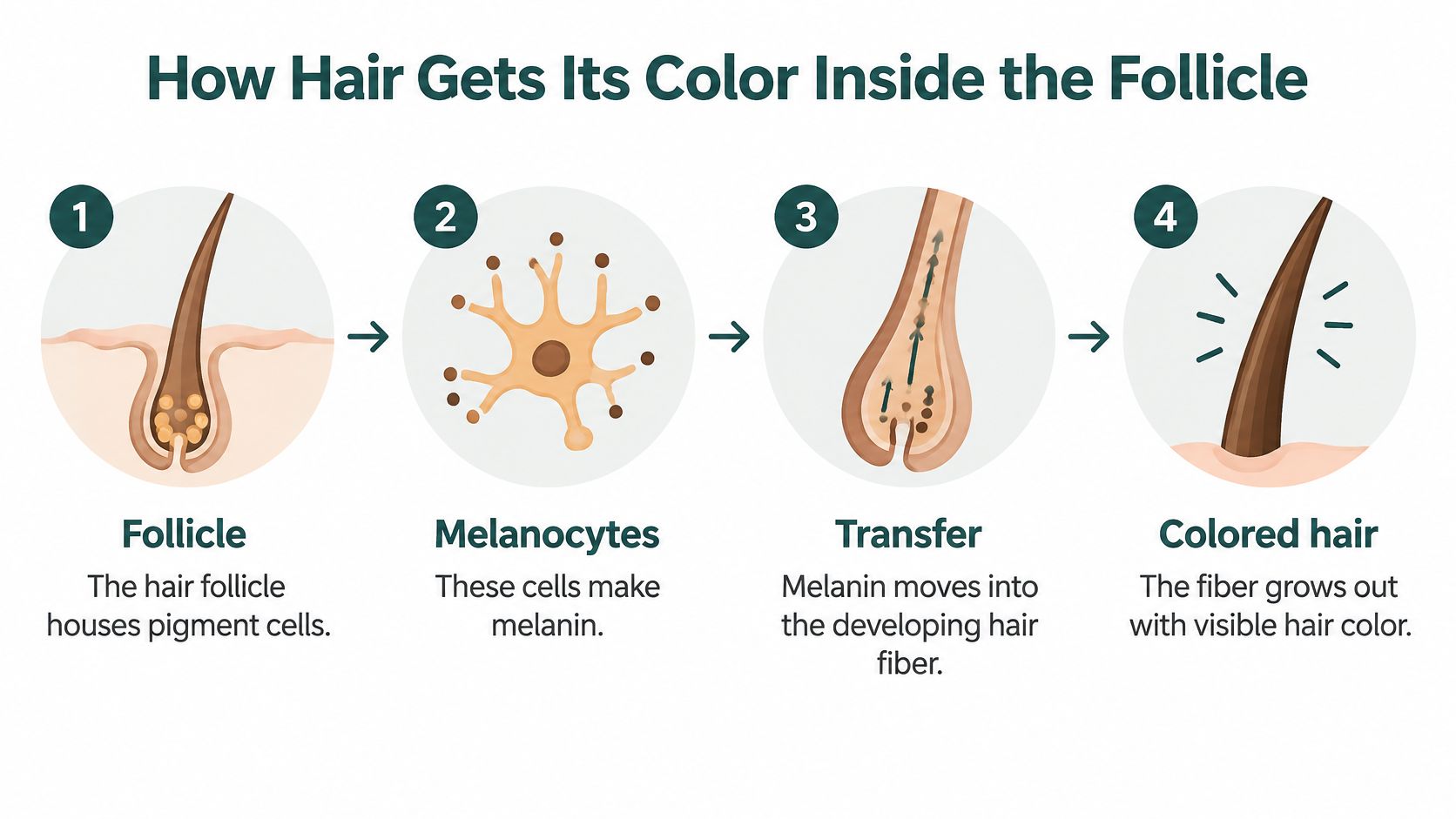
The assembly line runs in a fixed order. Melanocytes take up the amino acid tyrosine, convert it to L-DOPA, and oxidize that to dopaquinone. The pathway then builds melanin and packs it into small organelles called melanosomes, which get transferred into neighboring keratinocytes, the hair-forming cells that harden into the shaft. Research on the melanin synthesis and transfer pathway describes that sequence in detail, and the sequence only runs while a fiber is being built.
Two pigments, one recipe
Two pigment families do the work. Eumelanin produces black and brown tones. Pheomelanin produces red, strawberry and warm light blond tones. Many people carry a blend of both, and the ratio between them sets the shade far more than either pigment acting alone.
Melanin types and the hair colors they shape
| Pigment pattern | Typical shades | How it shapes the color |
|---|---|---|
| High eumelanin | Black and dark brown | Large amounts give deep, dark shades |
| Lower eumelanin | Medium and light brown | Less pigment gives lighter brown tones |
| Dominant pheomelanin | Red, strawberry and warm light blond | Warm, reddish tones dominate |
| Mixed eumelanin and pheomelanin | Most natural brown and blond shades | The ratio of the two shifts shade |
Biological pigment is incorporated as the fiber forms. A supplement’s proposed biological action would concern the living follicle and future growth; shampoos, dyes and other cosmetics can also act directly on existing fibers without restoring follicular melanin production.
Why Pigment Production Slows as Follicles Age
A single follicle doesn't make one hair and retire. It runs repeated cycles of growth, rest and regrowth, and every new cycle needs a fresh crew of pigment cells. Melanocyte stem cells sitting in a pocket of the follicle called the bulge wake at the start of each growth phase, travel toward the hair bulb, and mature into pigment-producing melanocytes that stock the next fiber. The cycle of melanocyte stem cell activation and differentiation mapped in a landmark mouse and human study is what keeps color arriving cycle after cycle.
The output of that crew is out of all proportion to its size. A foundational review of hair follicle biology notes that a comparatively small number of melanocytes can produce enough pigment in a single growth cycle to intensely color as much as 1.5 meters of hair shaft. The same review estimates that an individual scalp follicle goes through roughly 7 to 15 cycles of melanocyte seeding or replacement during an average 45-year gray-free lifespan.
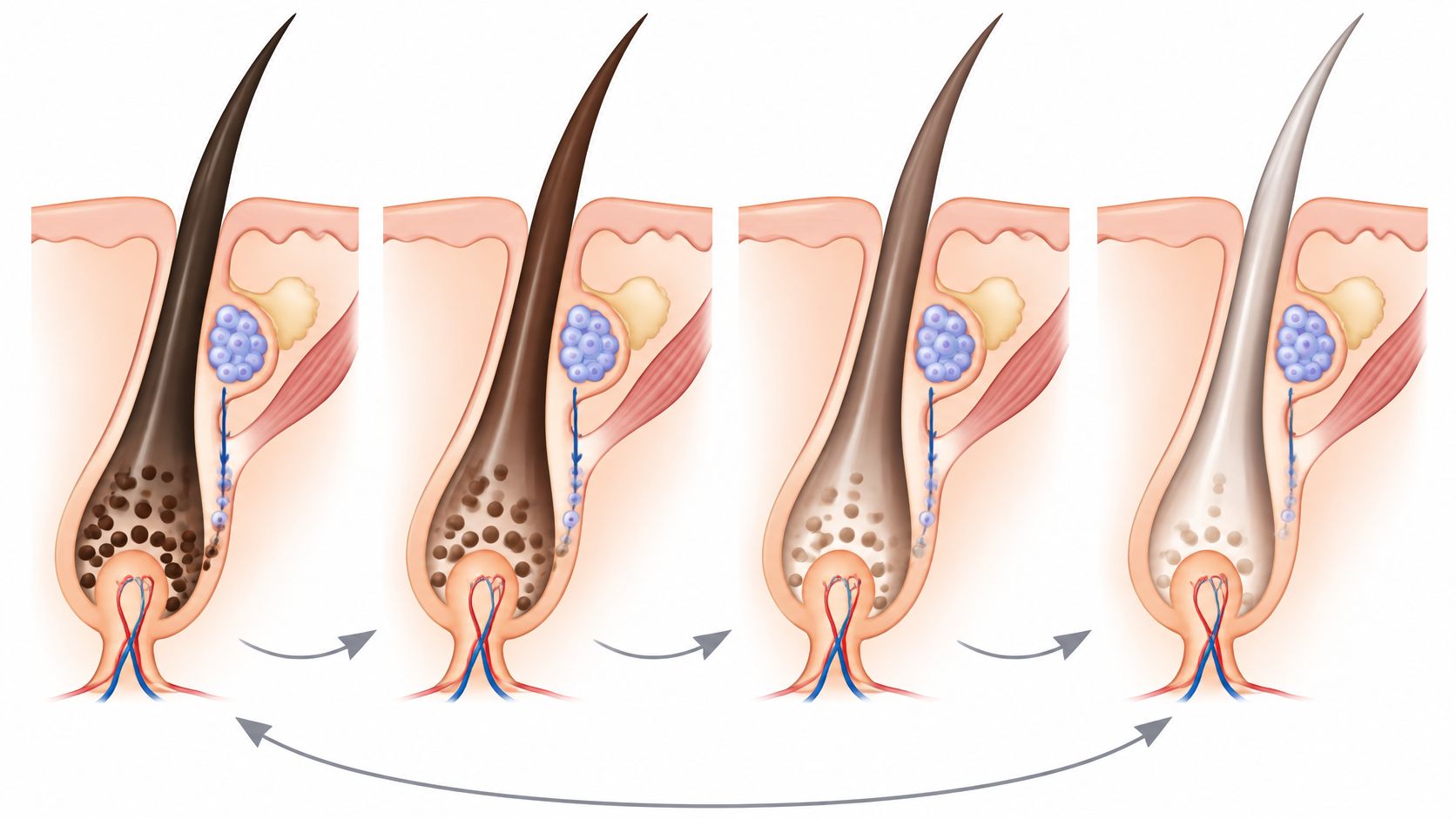
What a thinning supply looks like
Illustration note: the preceding diagram is a schematic of pigmentation changes across growth cycles, not a guaranteed reversible cycle or a supplement result. As melanocyte function or the stem-cell reservoir changes, newly formed fibers may contain less melanin. The mechanisms vary between follicles and individuals.
In a mouse study led by NYU researchers, aging melanocyte stem cells increasingly became lodged in the follicle bulge and failed to generate pigment-producing cells. This is animal mechanistic evidence, not a demonstration that a product reverses human graying. Primary source: https://pubmed.ncbi.nlm.nih.gov/37076619/
Why the strand you can see is finished
The fixed point: pigment is added while the fiber is being built. Afterwards the strand is a record, not a work in progress.
Cutting, washing or coating an existing shaft cannot restore pigment that fiber never received. No single normal age for graying exists, because timing and extent vary with ancestry, genetics, age and individual biology.
Genetics, Ancestry and Gray Hair Timing
Population studies are the only honest way to discuss when gray arrives, and they describe groups rather than people. A review of large population-based observations reports that approximately 6% to 23% of people have reached 50% gray hair by age 50, and the same review gathers mean onset ages that differ by ancestry group.
Reported gray hair onset by population group
| Population group | Reported typical onset | Interpretation |
|---|---|---|
| Caucasian (European ancestry) | Mid-30s | Historical group estimate, not an individual timetable |
| Asian | Late 30s | Historical group estimate, not an individual timetable |
| African or Black populations | Mid-40s | Historical group estimate, not an individual timetable |
These broad descriptions come from historical study populations, not a schedule for any individual. Timing varies substantially within groups; ancestry labels alone cannot predict when someone will gray.
What Genetics Controls
Genes sit upstream of everything else here. They influence how much melanin each follicle makes, which pigment type dominates, and how early the melanocyte supply starts to thin. All of that applies to pigment still being produced inside the follicle. Nothing in your genome adds color to a strand that already finished growing.
Natural hair color is a complex genetic trait. A genome-wide study of 343,234 white British UK Biobank participants identified many contributing variants and found that MC1R accounted for a large part of red-hair SNP heritability. These findings about natural hair color should not be treated as a clinical prediction of graying or evidence for a supplement. Primary study: https://pmc.ncbi.nlm.nih.gov/articles/PMC6288091/
A single-university Saudi survey conducted in 2023 and published in 2025 found that 1,035 of 2,644 respondents (39.1%) reported graying; 933 of those 1,035 (90.1%) said it began before age 25. These self-reported, selected-sample findings are not general-population prevalence estimates. Source: https://www.mdpi.com/2227-9032/13/10/1185
Why group averages don't forecast your hair
Family history and ancestry can shift what you expect and when. They can't tell you the month.
Your follicles follow your own genome, not a population mean. Two parents who grayed early move your expectation earlier, whatever the table says. If graying arrives much earlier than is typical for your ancestry group and family history, that pattern is a reason to review the wider picture with a clinician rather than to buy a formula.
What Nutrition and Oxidative Stress Can and Cannot Explain
The popular version of this story goes: gray hair is an antioxidant problem, so an antioxidant pill should fix it. The first half has real support. The second half doesn't follow from it.
A primary study reported millimolar hydrogen peroxide accumulation in gray and white scalp hair shafts, alongside reduced catalase and methionine sulfoxide reductase expression. This supports investigation of oxidative processes; it does not establish that an oral antioxidant or finished supplement restores color. Primary source: https://pubmed.ncbi.nlm.nih.gov/19237503/
What that finding does and doesn't do: it gives antioxidant support a biological rationale. It doesn't show that swallowing a capsule changes pigment in a human follicle.
Sorting evidence by what it can support
Evidence levels behind hair pigment claims
| Evidence type | What it can support | What it cannot prove |
|---|---|---|
| Cell and tissue studies of follicles | Biological plausibility for oxidative stress in graying follicles | That any supplement restores pigment |
| Mouse experiments | Mechanisms of melanocyte stem cell aging | Repigmentation in humans |
| Observational human associations (for example, stress) | Factors linked with earlier or changing graying | That correcting one factor reverses gray hair |
| Correction of a confirmed nutrient deficiency | Restoring normal status where a deficiency exists | Reversal of normal age-related gray hair |
| Randomized trials of the same finished formula | Effect of that formula at its dose, measured by its outcome | Results for other ingredients or products |
Mechanistic research can help explain follicle biology without establishing that a commercial supplement changes hair color. The cited Cell Discovery paper is an original single-cell study, not a review or a randomized trial of a finished formula. Primary study: https://www.nature.com/articles/s41421-022-00394-2
Nutrition splits into two separate questions. Correcting a documented deficiency is a clinical matter with a lab result attached. Adding extra nutrients to someone whose status is already adequate has no established effect on gray hair. A reversal claim has to meet one standard: human intervention data using the same ingredient, at the same dose, in the same formulation, measured by the same outcome.
Can Gray Hair Regain Pigment or Is It Cosmetic
Pigment already locked into a grown strand does not come back. An active follicle can still make pigment for new growth, so any real change in color appears only in the segment that forms after the change.
A small observational study mapped pigmentation along individual hairs from 14 volunteers and documented naturally occurring pigment changes. Exploratory retrospective stress-timeline comparisons involved only two participants. These observations do not establish that stress reduction causes repigmentation or that any supplement reliably restores gray hair. Primary study: https://elifesciences.org/articles/67437
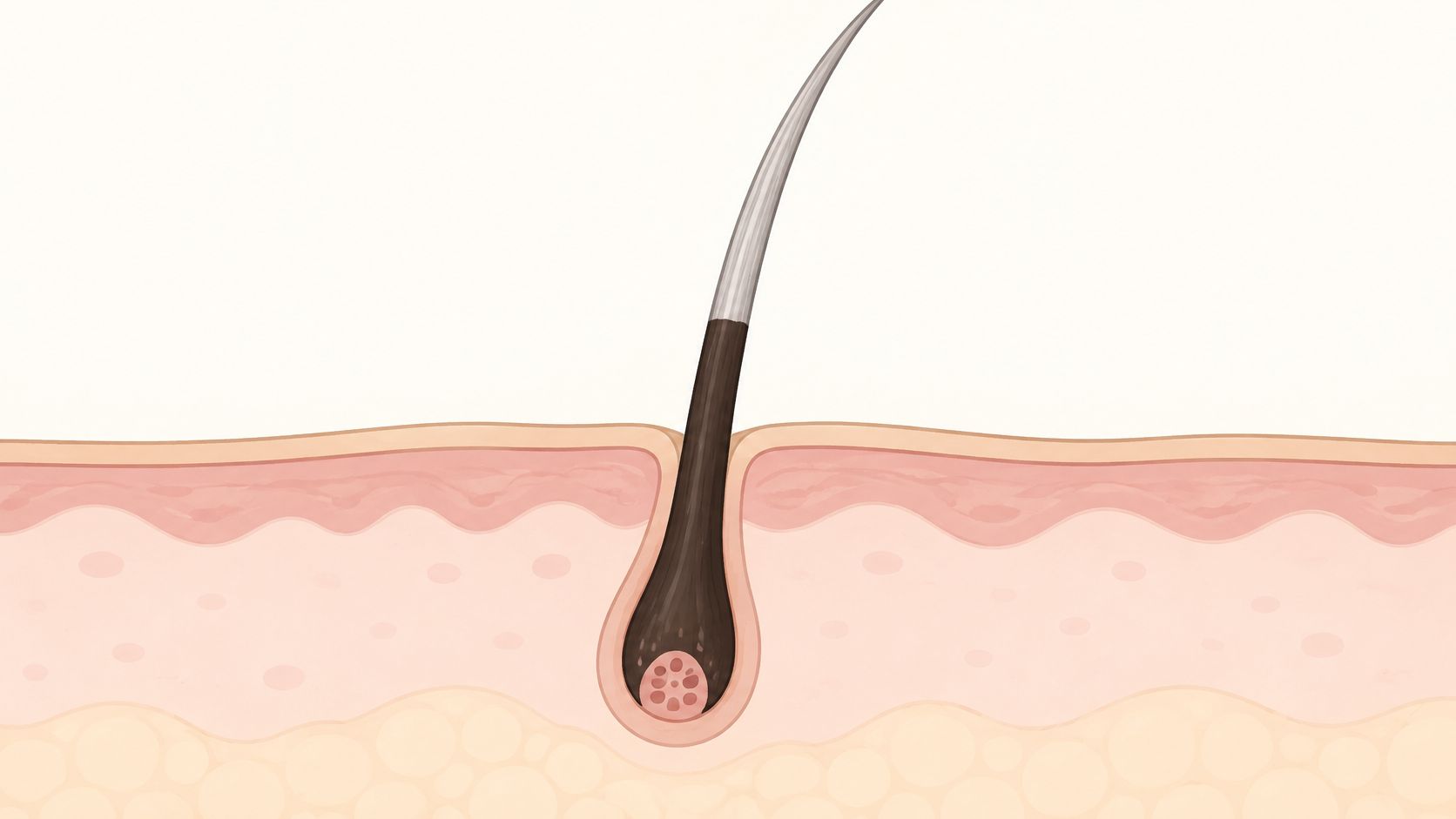
Illustration note: the preceding image depicts new darker growth near the root below older unpigmented hair, not existing white fiber repainting itself. It is an explanatory drawing, not a clinical before-and-after or a supplement result. Separate mouse research suggests acute stress can deplete melanocyte stem cells; animal mechanisms are not treatment plans.
A single strand can carry two colors along its length. Nothing shows the biology of pigment production changing over time more clearly than that.
Sorting the five things you might actually be seeing
Pigment change, cosmetic color and hair loss compared
| What you see | What is happening | Can biological pigment return? |
|---|---|---|
| Gray or white strands already grown out | Shaft formed with little or no melanin | No, the existing fiber does not recolor |
| New strands coming in darker | Active follicle producing melanin in new growth | Possible, visible only in new growth |
| Steadily more gray new growth | Declining melanocyte function or stem cell reservoir | Not established as reversible with any product |
| Color after dye or toner | Cosmetic alteration of existing hair; effects vary by dye or toner | Not biological repigmentation; some colors fade while permanent dyes can last until hair grows out |
| Thinning or shedding | Loss of hair density, not loss of pigment | Different problem; assess separately |
Biological repigmentation has been observed in some people, but the mechanistic and observational studies discussed here do not establish that ZERO GRAY or another finished supplement restores hair color. Cosmetic coloring of existing shafts is a separate process.
When Pigment Changes Need a Medical Check
Sudden or unusual pigment change is a reason to book an appointment, not a reason to guess at a formula. The threshold is straightforward: a change that's faster, earlier or more patchy than expected deserves a professional look before anything gets added to the routine.
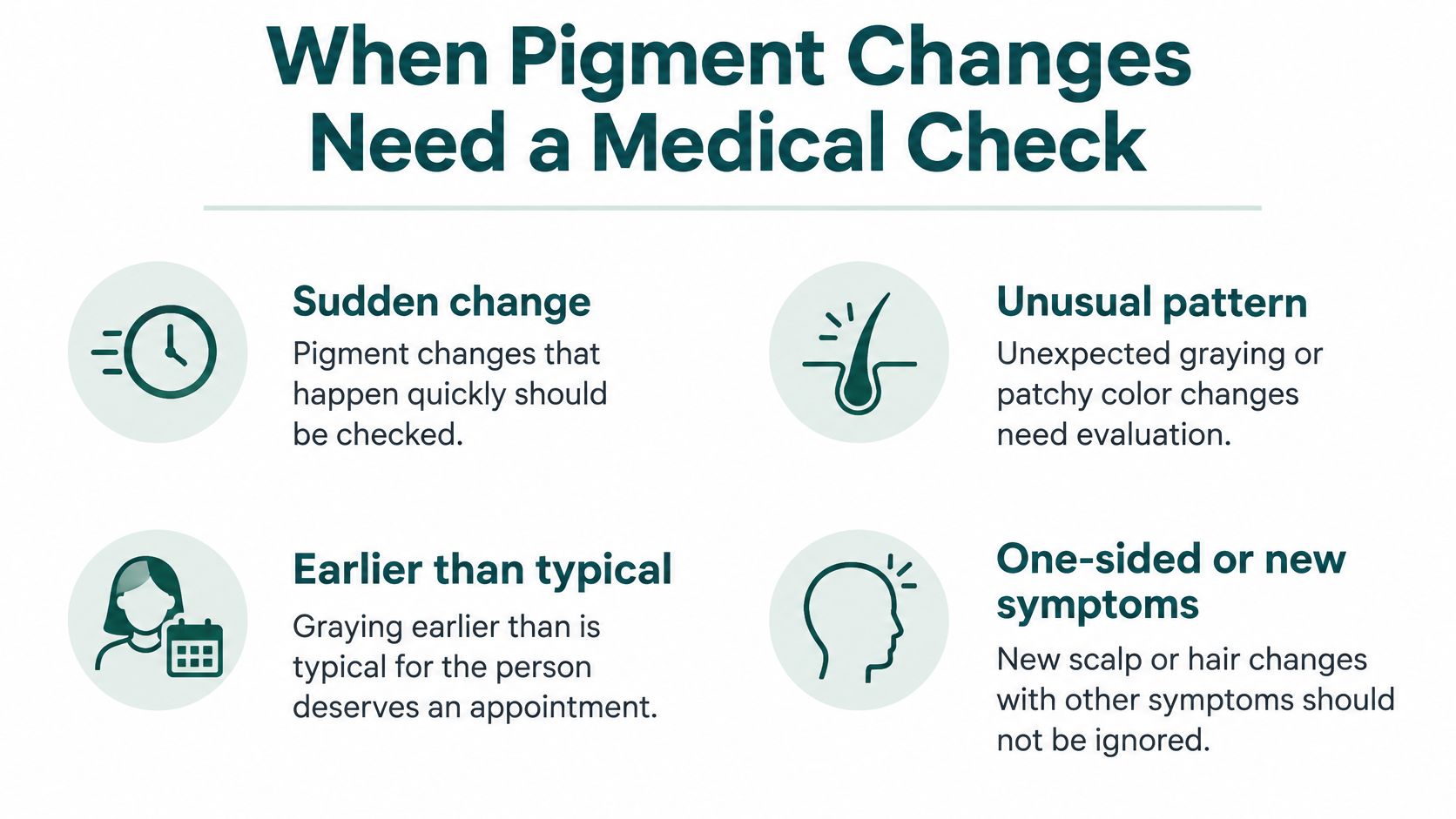
The signals worth acting on
- Faster than expected: color loss moving over weeks or months rather than years.
- Earlier than typical: graying well ahead of what a reader's ancestry group and family history would suggest.
- An unusual pattern: defined patches of white rather than an even scatter.
- Change alongside scalp symptoms: itching, tenderness or scaling with the color shift.
- A new medication: timing that lines up with a prescription change.
- Whole-body symptoms: fatigue, unexplained skin changes, dizziness or urinary symptoms.
What a clinician can actually check
A clinician reviews medical history, current medicines and supplements, and diet, then orders laboratory tests where they're clinically indicated. That process establishes whether a deficiency or another contributor exists. This article doesn't diagnose any deficiency, and a supplement doesn't substitute for the assessment.
Measuring pigment outcomes is hard. New growth reflects follicle biology over time, and association between a factor and graying is not evidence that correcting that factor reverses it.
A short checklist for the visit
Bring the date the change started, whether it's one area or all over, what else has changed in health or routine, every medicine and supplement currently taken, and whether hair loss is happening at the same time. Those five answers save a lot of guesswork.
Safety Considerations Before Taking Any Hair Supplement
Hair-labeled supplements carry the same safety considerations as any other supplement, and the first one is arithmetic. Add up daily amounts from every product in the routine and compare the total against the daily value and any upper limit a clinician or an authoritative source sets. Stacking two or three formulas raises intake quickly, and nobody notices because each label looked reasonable on its own.
Warnings about combining nutrients are not proof that an alternate-day schedule or any other reshuffling is safe. They mark a question worth asking.
Some readers should talk with a clinician before starting anything. That includes people who are pregnant or breastfeeding, people with kidney, liver or thyroid conditions, people taking prescribed medicines, and anyone currently being treated for a confirmed deficiency. Supplements don't replace prescribed care, and they must not be used to manage alcohol withdrawal.
Botanical and extract safety is product-specific. A finding about one extract doesn't generalize to all products, and safety for one formula says nothing about another. Trial doses and durations are research parameters, not self-treatment instructions. Copper is a good example of an ingredient that needs its own careful treatment of dose and safety, and it's covered in the guide to copper supplements for gray hair.
If unexpected symptoms appear after starting a product, stop it and seek care.
Checking a Supplement Label Without Overclaiming
A Supplement Facts panel works like a receipt: it shows what was put in the bottle, not what the bottle will do. For gray hair, keep three claims separate while you read: pigment still being made inside the follicle, pigment already locked into a grown strand, and temporary color applied from outside. A supplement label can speak only to the first category. It cannot repaint a strand that has already grown, and it is not a dye.
Run this routine before buying anything.
- Start with the serving size. Note both the serving size and the servings per container, since a 30-day supply and a 60-day supply can look identical at a glance.
- List every ingredient with its amount per serving. Compare each amount against the daily value and any limit a clinician has advised.
- Check the form. Ingredient forms differ in how they're described and labeled, and the panel is the only place that says which one is in the bottle.
- Ask what testing covers. Confirm for that specific product whether the page says what testing includes and whether any ingredients sit in a proprietary blend. Don't extend one product's testing to a whole brand.
- Compare the label image with the product description. Where the two conflict, flag the conflict instead of picking the more convenient number.
- Match the evidence to the ingredient. Separate mechanism, deficiency correction and trial data on a finished product. They aren't interchangeable.
Judge antioxidant wording by the specific compound, dose and human evidence, never by the word itself.
Test before you buy: a label tells you what's in the bottle, never what it will do.
Apply that routine to ZERO GRAY, Newt Nutrition's hair pigmentation formula. Open the product page, find the Supplement Facts panel, and read it line by line: serving size, servings per container, each named ingredient, each amount, and whether any blend hides individual doses. Then match those entries to the three pigment categories above before assuming anything about results. A plausible pathway is still only a pathway until human trials test that finished formula. These statements have not been evaluated by the Food and Drug Administration. This product is not intended to diagnose, treat, cure, or prevent any disease.
Newt Nutrition publishes plain-language ingredient breakdowns and label-first product pages for people who want to know exactly what they're taking before they spend money. If you want to compare hair formulas on the same terms this article used, with each ingredient and amount written out, the Newt Nutrition catalog is the place to start. Read the Supplement Facts panel first, match it to what the evidence supports, and skip anything that promises your color back.

